
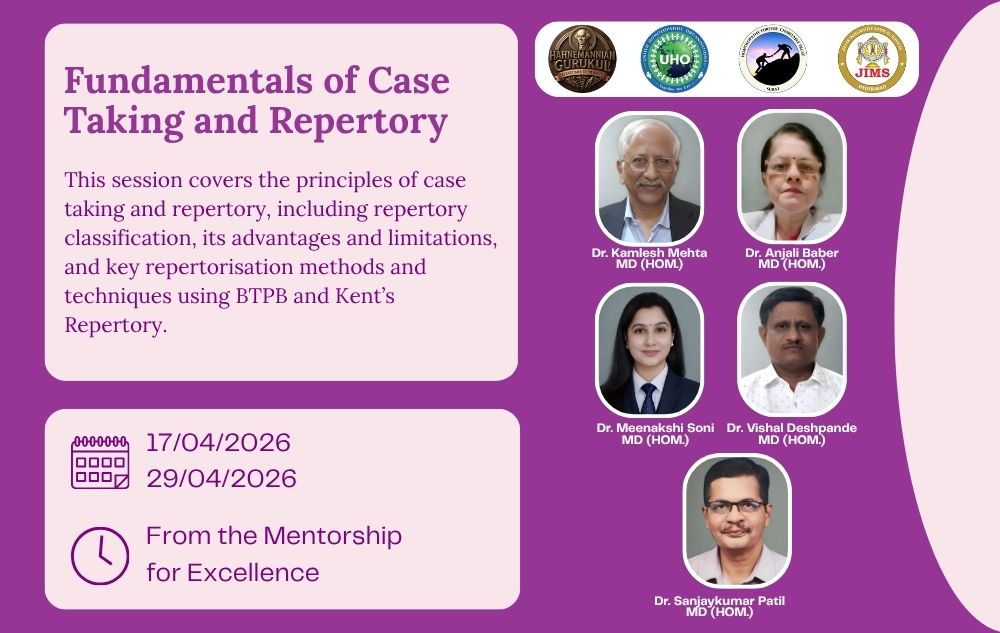
Recorded videos from the Mentorship for Excellence – Fundamentals of Case Taking and Repertory series conducted between 17th April and 29th April 2026, featuring Dr. Kamlesh Mehta, Dr. Anjali Baber, Dr. Meenakshi Soni, Dr. Vishal Deshpande, and Dr. Sanjaykumar Patil. The sessions focus on examination-oriented preparation, repertory concepts, classification of repertories, repertorisation techniques, Boenninghausen's Concordance, and comparative study of Kent's Repertory and Boenninghausen's Therapeutic Pocket Book (BTPB).
This session provides strategic advice for university students on how to effectively structure exam answers regarding the scopes and limitations of homeopathical repertories by using detailed explanations and practical clinical examples to score higher marks
This session outlines academic strategies, key topics, and structural frameworks to help students achieve excellence in BHMS examinations for case taking and repertory
This session provides a comprehensive guide to the six methods and various techniques of repertorization designed for university exam preparation. It emphasizes strategic test-taking practices, including effective time management, structured answering, and avoiding confusion between methods and techniques.
This session details how homeopathic repertories are classified across four specific levels: overall appearance, internal formatting, coverage, and philosophy, to aid in academic study and clinical utilization. It emphasises that thorough case taking is a strict prerequisite to repertorization, as the unique characteristic demands of a patient's case dictate which specific type of repertory should be selected for practice
This presentation explains Boenninghausen’s concordance chapter as a clinical index of harmonious or disharmonious drug relationships, rather than a theoretical tool. It details how the concordance can guide both first and second prescriptions by mapping remedies through concentric circles based on grading similarities.
This session analyses and compares the philosophical foundations, structures, scopes, and limitations of both Kent's Repertory and Boenninghausen's Therapeutic Pocket Book (BTPB). It highlights how understanding their underlying logic, specifically inductive versus deductive logic, is essential for effective clinical application and case analysis in homeopathy.
In this comprehensive six-part module, experienced faculty explore the essential principles of Homoeopathic Case Taking and Repertory, equipping students with a structured understanding of repertory concepts, case analysis, and repertorisation techniques. The series bridges theoretical foundations with practical clinical application, helping learners develop systematic approaches to case processing, remedy selection, and examination preparation.
The sessions cover examination-oriented study strategies, the advantages and limitations of repertories, classification and types of repertories, methods and techniques of repertorisation, Boenninghausen's Concordance, and a comparative understanding of Kent's Repertory and Boenninghausen's Therapeutic Pocket Book (BTPB). Together, these topics strengthen students' conceptual clarity while enhancing their ability to confidently approach university examinations and clinical case analysis. These subjects align with the BHMS curriculum, which emphasizes case taking, repertorial totality, rubric selection, and the practical use of repertories in finding the similimum.
Understanding the scope, utility, strengths, and limitations of homoeopathic repertories, along with practical strategies for presenting structured examination answers.
Examination-focused preparation techniques, recommended study frameworks, high-yield topics, and systematic approaches for mastering repertory concepts.
Comprehensive coverage of repertorisation methods, techniques, rubric selection, case analysis, and effective strategies for applying repertory principles in clinical practice.
Study of various repertory classifications based on construction, philosophy, structure, and clinical utility, enabling students to choose the appropriate repertory for different clinical situations.
An in-depth exploration of Boenninghausen's Concordance, remedy relationships, concentric circles, and its role in first and subsequent prescriptions.
A comparative study of Kent's Repertory and Boenninghausen's Therapeutic Pocket Book, highlighting their philosophical foundations, structures, repertorial approaches, clinical applications, and limitations.
Recorded videos from the Mentorship for Excellence – Fundamentals of Case Taking and Repertory series conducted between 17th April and 29th April 2026, featuring Dr. Kamlesh Mehta, Dr. Anjali Baber, Dr. Meenakshi Soni, Dr. Vishal Deshpande, and Dr. Sanjaykumar Patil. The sessions focus on examination-oriented preparation, repertory concepts, classification of repertories, repertorisation techniques, Boenninghausen's Concordance, and comparative study of Kent's Repertory and Boenninghausen's Therapeutic Pocket Book (BTPB).
We use cookies and anonymous visitor insights to enhance our website and improve your experience. By using our site, you agree to our use of cookies.
Manage your cookie preferences below:
Essential cookies enable basic functions and are necessary for the proper function of the website.