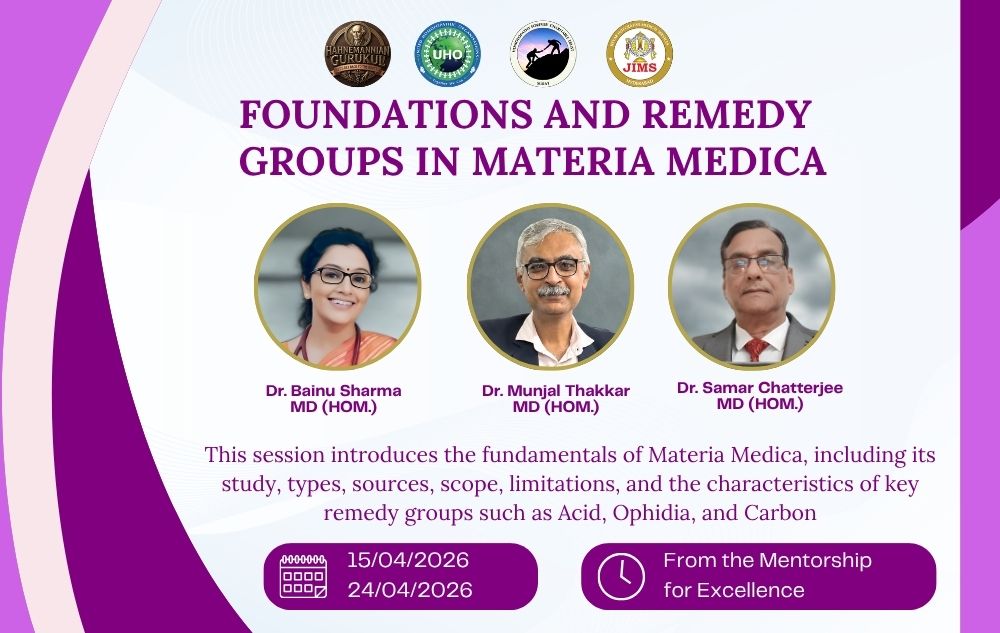
Recorded videos from the Mentorship for Excellence Materia Medica series conducted on 15th and 27th April 2026, featuring Dr. Munjal Thakar, Dr. Samar Chatterjee, and Dr. Bainu Sharma. The sessions focus on the foundations of Materia Medica, effective study methodologies, scope and limitations, and the clinical understanding of key remedy groups, including Acid, Ophidia, and Carbon.
This educational session delivers strategic advice on how to intelligently study homeopathic Materia Medica by utilising structured book selection and memory retention formulas. It also equips medical students with the confidence and practical tactics needed to guide their own oral examinations actively.
The video provides an overview of the scope and limitations of the Homeopathic Materia Medica, explaining how its extensive record of subjective human symptoms aids in holistic patient treatment while noting challenges such as a lack of animal testing data, vast amounts of text to memorize, and its insufficiency in managing acute medical emergencies.
A homeopathic material medica session provides a detailed overview of the acid group's symptoms, causative factors, and clinical indications for structured student examination framing.
The video provides a detailed overview of the homeopathic remedy Lachesis, focusing on its application for female patients by detailing their physical constitution, behavioural stages, and specific menstrual and menopausal symptoms.
In this comprehensive module, the faculty guide learners through the essential principles of Homeopathic Materia Medica, beginning with effective study methodologies and progressing to the practical understanding of remedy groups and their clinical applications. The sessions explore the structure, scope, and limitations of Materia Medica while demonstrating how group study can simplify the understanding of remedies through common themes, characteristics, and clinical patterns.
By integrating foundational concepts with remedy group analysis, this series equips students and practitioners with a systematic approach to mastering Materia Medica, enhancing both examination performance and day-to-day clinical decision-making.
Strategic Study of Materia Medica: Practical guidance on selecting appropriate study resources, improving memory retention, and developing structured learning techniques to confidently navigate oral and written examinations.
Types, Sources, Scope, and Limitations of Materia Medica: An in-depth exploration of the various forms and sources of Materia Medica, its role in holistic patient care, and the practical limitations practitioners must recognise.
The Acid Group – Core Themes and Clinical Applications: Understanding the characteristic symptomatology, causative factors, constitutional traits, and therapeutic indications of remedies belonging to the Acid group.
The Ophidia Group through Lachesis: A focused study of Lachesis as a representative Ophidia remedy, examining its mental, physical, menstrual, and menopausal characteristics, particularly in female patients.
Comparative Remedy Group Approach: Learning how remedy group analysis facilitates faster remedy differentiation, deeper conceptual understanding, and more efficient clinical prescribing.
Recorded videos from the Mentorship for Excellence Materia Medica series conducted on 15th and 27th April 2026, featuring Dr. Munjal Thakar, Dr. Samar Chatterjee, and Dr. Bainu Sharma. The sessions focus on the foundations of Materia Medica, effective study methodologies, scope and limitations, and the clinical understanding of key remedy groups, including Acid, Ophidia, and Carbon.
We use cookies and anonymous visitor insights to enhance our website and improve your experience. By using our site, you agree to our use of cookies.
Manage your cookie preferences below:
Essential cookies enable basic functions and are necessary for the proper function of the website.