
-
1
 Part 1/ 6 Fundamentals Of The Second Prescription & Action Of Remedies | Dr Kavita Sawant
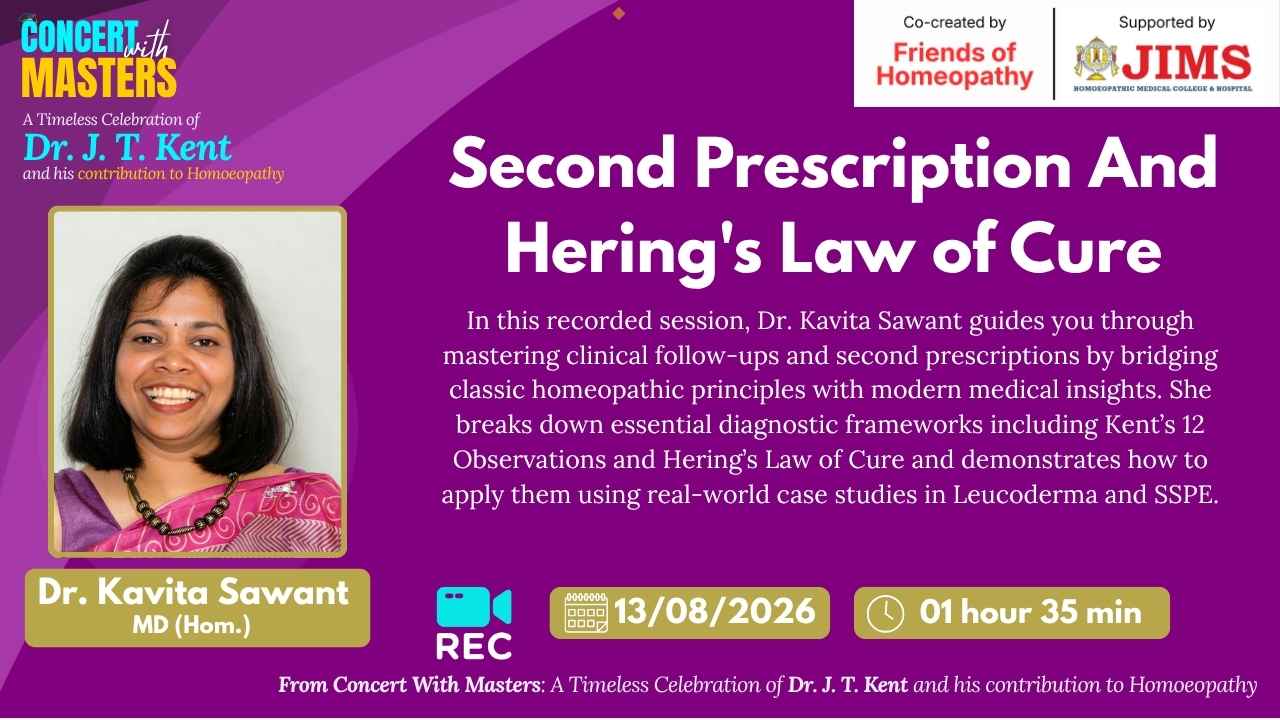
In this recorded session, Dr. Kavita Sawant introduces the core fundamentals behind the second prescription and remedy action. She outlines the key principles needed to evaluate initial patient responses and make accurate, confident follow-up decisions in clinical practice. Drawing upon the foundational teachings of Dr. Samuel Hahnemann, Dr. Constantine Hering, and Dr. James Tyler Kent, Dr. Sawant addresses common clinical dilemmas—such as knowing when to repeat a remedy, change it, or simply wait and watch—providing a structured framework to replace follow-up confusion with clinical certainty
-
2
Part 2/ 6 Kent's 12 Observations | Dr Kavita Sawant
In this recorded session, the speaker explains that a homeopathic remedy acts only as a vital stimulus, meaning the patient ultimately heals themselves. Practitioners must maintain a strict "hands off" approach and avoid interfering while a curative reaction is actively in progress. A second prescription should only be introduced if the patient begins to slip back or original symptoms return. Furthermore, when managing transfer patients from another classical homeopath, a practitioner must conduct a tedious inspection of all symptoms instead of rushing into a new prescription.
-
3
Part 3/ 6 Hering's Law And Remedy Changes | Dr Kavita Sawant
In this session, Dr. Kavita Sawant outlines guidelines for prescribing and managing remedy changes based on Dr. Kent's teachings and Dr. Vijayakar's modern integration of Hering’s Law. She emphasises that if an initially correct remedy (simillimum) loses its efficacy over time, the physician must step up the potency rather than change the remedy. Furthermore, the return of forgotten, older symptoms indicates a proper curative reversal toward healing and should not be interfered with. Conversely, entirely new, painful, or dangerous symptoms signify an improper "suppression" of disease from a less important organ to a highly important organ (such as rheumatism of the knee shifting to the heart), requiring a change in the prescription.
-
4
Part 4/ 6 Leucoderma Case Presentation | Dr Kvita Sawant
In this session, Dr. Kavita Sawant outlines how a 14-year-old boy with ADHD, severe behavioural issues, and leucoderma was treated with Opium 200 in July 2019. Following treatment, his concentration and grades significantly improved, and his aggressive behaviour stopped as he successfully made friends. His leucoderma patches healed systematically according to physiological laws: clearing first from the forehead and face, moving downward to the hands, and lastly to the legs. The healing followed a within-outward, dorso-ventral gradientclearing the centre of the face and ears before the area under the eyes, while temporary new patches at the periphery and lower levels (feet and thumbs) confirmed the disease was properly leaving the body
-
5
Part 5/ 6 Treatment and Recovery of an SSPE Case Study | Dr Kavita Sawant
In this session, Dr. Kavita Sawant outlines how a 2-year-old girl presented with complete developmental arrest, hearing loss, loss of motor functions, and severe, frequent head dropping. Her symptoms emerged after a measles infection at 6 months of age, which was treated with heavy antibiotics and subsequently progressed into subacute sclerosing panencephalitis (SSPE). Her clinical reports showed elevated measles IgG levels and early SSPE changes on her MRI. Based on an analysis of her physical and sensory symptoms, a single dose of Belladonna 10M was prescribed.
-
6
Part 6/ 6 Reflections on Kent's Teachings and Conclusion | Dr Kavita Sawant
The session concludes with a brief Q&A, a display of the requested seven-layer chart, and expressions of gratitude to the host institution and colleagues. The closing summary highlights how the presentation beautifully integrated the classical teachings of Kent, Hering, and Dr. Vijayakar through practical case reviews, while reinforcing the importance of patience and proper course correction in homeopathic practice.
-
7
 Feedback Form