
-
1
 Part 1/ 8 Hahnemann's Foundation of Miasms | Dr M K Kamath
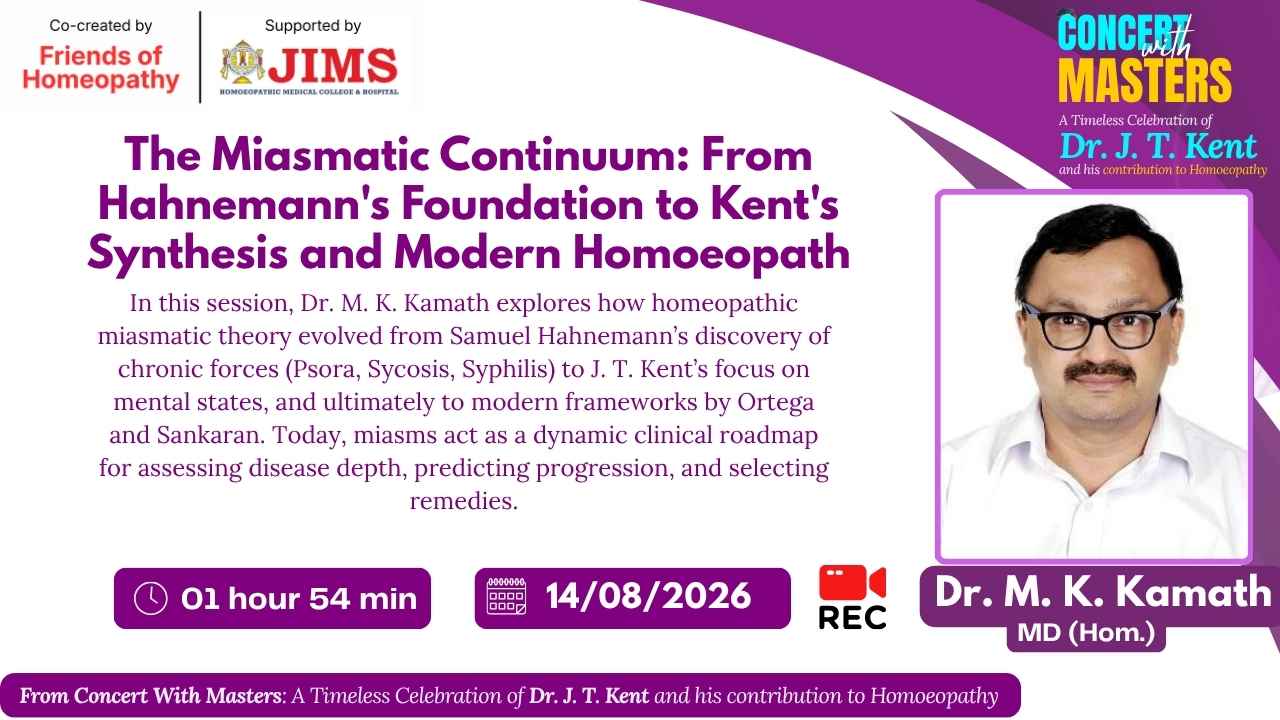
In this session, Dr. M. V. Kamath focused on the miasmatic continuum, exploring Samuel Hahnemann's original foundation, subsequent improvisations by James Tyler Kent, and modern developments in homeopathy. It highlighted how Hahnemann spent 12 years investigating why standard acute prescribing methods consistently failed to provide sustained relief for chronic diseases.
-
2
Part 2/ 8 The Three Primary Miasms | Dr M K Kamath
In this session, Dr. M. V. Kamath focused on how Samuel Hahnemann identified three fundamental chronic miasms Psora (deficiency), Sycosis (excess), and Syphilis (destruction) which act as dynamic forces that derange the vital force, evolve over a patient's lifetime, and accumulate across generations. Suppressing their external, peripheral manifestations drives the underlying disorder deeper into vital internal organs, creating severe systemic complaints. To achieve a genuine cure, deep-acting anti-miasmatic remedies are required to safely reverse this progression, moving the pathology from vital centres back to the periphery.
-
3
Part 3/ 8 Historical Gap: Hahnemann to Kent | Dr M K Kamath
In this session, Dr M. V. Kamath focused on how, following Samuel Hahnemann's death in 1843, a deep philosophical division emerged within the homoeopathic profession between strict Hahnemannians and those favouring low-potency, conventional drug-aligned prescribing. While bridging figures like Constantine Hering, T.F. Allen, G.H. Allen, and J.C. Burnett worked to expand and systematically document the miasm theory and remedies, opposing schools like Richard Hughes' sought to reduce homeopathy to matching pathological diagnoses with physiological doses. Ultimately, J.T. Kent's extensive philosophical and clinical synthesis arose as a direct defence of Hahnemann's original heritage against this reductionist, pathological trend
-
4
Part 4/ 8 Kent's Philosophical Miasmatic Lens | Dr M K Kamath
In this session, Dr. M. V. Kamath focused on how James Tyler Kent was a prominent figure in classical homeopathy who systematised the miasm theory by integrating it into a comprehensive philosophical framework using a cosmological scaffolding. He established a strict hierarchy of disease and symptoms running from the interior to the exterior, prioritising mental and emotional symptoms over physical ones. Through this approach, Kent characterised the three fundamental miasms: Sora, Psychosis, and Syphilis, by mapping their specific mental, emotional, and physical patterns to guide deep constitutional prescribing.
-
5
Part 5/ 8 Kent's use of Miasm in Case Taking | Dr. M. K. Kamath
In this session, Dr. M. V. Kamath focused on how James Tyler Kent’s homoeopathic method integrates miasmatic assessment directly into case-taking, focusing hierarchically on mental and emotional symptoms as the primary indicators of a patient's dominant miasmatic layer. Physical symptoms and medical histories serve as a secondary tier for cross-referencing and confirming these insights. In cases where a well-indicated constitutional remedy fails to act due to a deep miasmatic obstruction, deep-acting nosodes such as Psorinum are structurally utilised as intercurrent stimuli to unlock the case and enable the primary remedy to bring about a cure.
-
6
Part 6/ 8 Beyond Kent: Twentieth Century Refinements | Dr. M. K. Kamath
In this session, Dr. M. V. Kamath focused on how twentieth-century homoeopathic developments shifted miasmatic theory from physical pathology to subjective perception and sensation. Artega Sanchez introduced the tubercular miasm as a hybrid of psora and syphilis, clinically marked by rapid oscillations between intense energy and sudden exhaustion. Rajan Shankaran reframed miasms as distinct patterns of felt perception and urgency mapped across a ten-position spectrum. Additionally, George Vithoulkas designed a "levels of health" framework to assess miasmatic depth and prognosis, while M.L. Dhawale integrated disciplined miasmatic assessment into chronic case analysis within the Indian classical tradition.
-
7
Part 7/ 8 Contemporary Clinical Miasmatic Applications | Dr. M. K. Kamath
In this session, Dr. M. K. Kamath focused on how; Contemporary classical homeopathy has shifted the miasm concept from a historical infective model to a functional, psychological framework used across various clinical methods. This framework serves as a practical, prognostic, and analytical tool for understanding chronic disease, guiding remedy potencies, and determining prescription depth. Despite internal criticisms regarding reductionism and a lack of randomised controlled trial evidence, its application remains grounded in extensive clinical observation and long-term empirical tradition.
-
8
Part 8/ 8 Reviewing Clinical Case Studies | Dr. M. K. Kamath
In this session, Dr. M. K. Kamath explores the evolution of miasmatic theory in homeopathy through various clinical case studies. It traces the concept over nearly two centuries from Samuel Hahnemann to modern figures like Rajan Sankaran, showing how it helps practitioners understand chronic disease resistance. Ultimately, the speaker emphasises that miasmatic theory is a living, self-correcting tradition that should serve as a deeper framework for case management rather than a shortcut to prescribing.
-
9
 Feedback Form