-
1
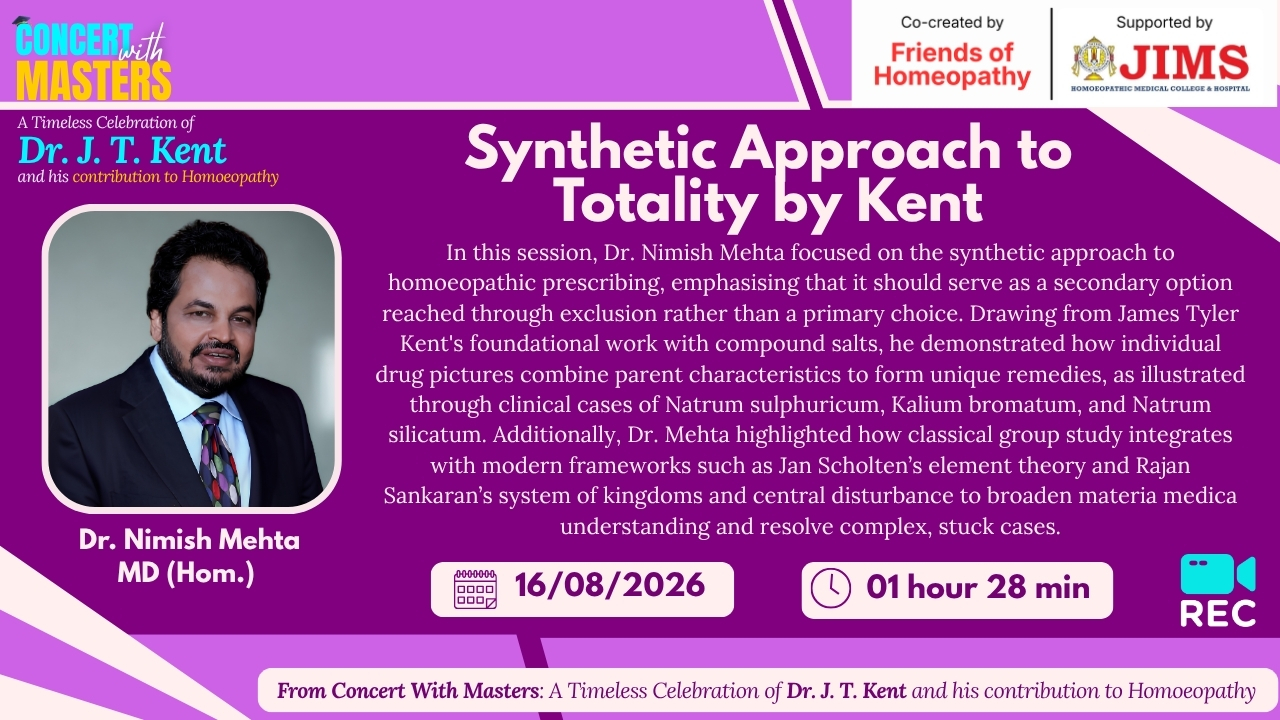
 Part 1/8 Synthetic Homeopathic Prescribing | Dr. Nimish Mehta
In this session, Dr. Nimish Mehta focused on the synthetic approach to homeopathic prescribing, emphasising that it should serve as a secondary option reached through exclusion rather than a primary choice. Drawing from his early experiences and training at the Institute of Clinical Research (ICR), he demonstrated how individual case pictures can combine distinct parent characteristics to form unique remedies, such as the junction of Arsenicum and Antimonium tart features in complex respiratory cases. Additionally, Dr. Mehta highlighted the importance of staying grounded in foundational roots and classical methodologies, including single symptom, keynote, and repertorial approaches, to thoroughly evaluate totalities before considering synthetic remedy relationships to resolve stuck or complicated cases.
-
2
Part 2/8 Kent's View and Historical Criticism | Dr. Nimish Mehta
In this session, Dr. Nimish Mehta explores Dr. James Tyler Kent’s evolving methodologies for teaching Materia Medica, focusing on his exploration of combined salts and synthetic remedy concepts. It details the historical criticism and evidence-based challenges he faced from contemporaries like Dr. H. C. Allen, which led Kent to scale back his publications and refine his prescribing approach. Through clinical case examples, the speaker illustrates how Kent prioritised distinctive individual characteristics, such as peculiar mental symptoms, over simple remedy combinations when determining the appropriate cure.
-
3
Part 3/8 Homeopathic Repertory & Synthetic Prescribing | Dr. Nimish Mehta
In this session, Dr. Nimish Mehta highlights the relationship between repertories and Materia Medica, emphasising that modern computerised repertories contain only a fraction of full Materia Medica data and often include erroneous additions. It traces how historical figures like Kent, Farrington, and Otto Leeser contributed to holistic, synthetic prescribing by observing drug pictures and family groups of salts rather than relying purely on physical symptoms. The speaker notes that modern group-study concepts build directly on these foundational, time-tested works to deepen understanding of remedies. Ultimately, synthetic prescribing is presented as a valuable secondary technique that must remain subordinate to standard case evaluation and repertorization methods
-
4
Part 4/8 Treatment of Seronegative Spondyloarthropathy | Dr. Nimish Mehta
In this session, Dr. Nimish Mehta presents a clinical case study of a male patient diagnosed with seronegative spondyloarthropathy accompanied by severe polyarticular joint pain, secondary osteoarthritis, and recurrent arthritic flare-ups. Initial case-taking uncovered deep-seated anxiety, self-centeredness, and a strong desire to avoid social and familial obligations beneath a casual, "happy-go-lucky" facade. Combining repertory analysis with extensive materia medica cross-referencing, the remedy Kali bromatum was selected, leading to rapid psychological improvements and a full physical recovery over two years. Consequently, the patient merged his business with his family's, married, and successfully resolved his chronic symptoms.
-
5
Part 5/8 Understanding Diverse Homeopathic Approaches | Dr. Nimish Mehta
In this session, Dr. Nimish Mehta discusses how various modern masters and practitioners, such as Jan Scholten, Dr. R. D. Jain, and Dr. Rajan Sankaran, have expanded the scope of homeopathic practice by introducing synthetic and systematic approaches. These varied methodologies are essential because patients present diverse clinical needs, ranging from acute situations to complex chronic cases requiring individual or group-level study. Rather than being restricted to a single traditional method of repertorization, practitioners are encouraged to keep an open mind and use different perspectives based on each case's unique demands. Clinical practice continues to evolve through these contributions, allowing remedies to be integrated via clinical success alongside traditional provings.
-
6
Part 6/8 Juvenile Arthritis and the Family Approach | Dr. Nimish Mehta
In this session, Dr. Nimish Mehta discusses details of a young male patient with severe juvenile arthritis who experienced significant trauma due to an abusive, alcoholic father. Despite facing constant physical abuse and chaos, the patient demonstrated passive resistance to his father's dominance. Utilising the Shankaran methodology and a synthetic family approach, the remedy Rhododendron (from the Ericaceae family) was selected based on his central experience of passive resistance. Within six months of treatment, the patient showed remarkable health and life improvements, demonstrating how kingdom, family, and central disturbance methodologies can guide effective remedy selection.
-
7
Part 7/8 Sinusitis & Survival Energy | Dr. Nimish Mehta
In this session, Dr. Nimish Mehta A 56-year-old male with chronic sinusitis and allergy issues initially presented irregular attendance and limited improvement, though he candidly acknowledged his fault for not following through with his treatment. His physical symptoms included recurrent, long-lasting cold and sinus distress aggravated by fan drafts, raw inflamed mucosa, bilateral wheezing, painful varicose veins, long-healing furuncles, lumbo-sacral spondylosis, and left-sided sciatica. Psychologically, despite suffering deep childhood trauma and severe beatings from his mother, accompanied by recent conflicts with a rebellious younger brother, he harbored a strong sense of family responsibility and refused to let his bitterness impact his filial duty or how he raised his children. By synthesizing his physical "Silica-like" ailments with his underlying "Natrum-like" survival energy and suppressed resentment, Dr. Nimish Mehta prescribed Natrum silicatum, which ultimately led to a successful long-term physical recovery and mental well-being.
-
8
Part 8/8 Conclusion & Application Summary | Dr. Nimish Mehta
In this session, Dr. Nimish Mehta emphasises that a synthetic approach should be applied when standard methods fail to deliver results, particularly by comparing drugs within mineral, plant, or animal families to established prototype remedies. Highlighting Kent's teaching to evaluate the entire picture rather than focusing solely on particulars, the speaker notes that this synthetic understanding is beneficial for learning Materia Medica and managing acute or partially improved cases. A case example illustrates how a patient on a constitutional remedy (Pulsatilla) facing an acute crisis was effectively treated with Aconite, a remedy from the same plant family, demonstrating how family similarity adds depth to prescription confidence and outcomes. Ultimately, maintaining an open mind to this structured approach enhances prescribing discipline and yields highly rewarding clinical results.
-
9
 Feedback Form