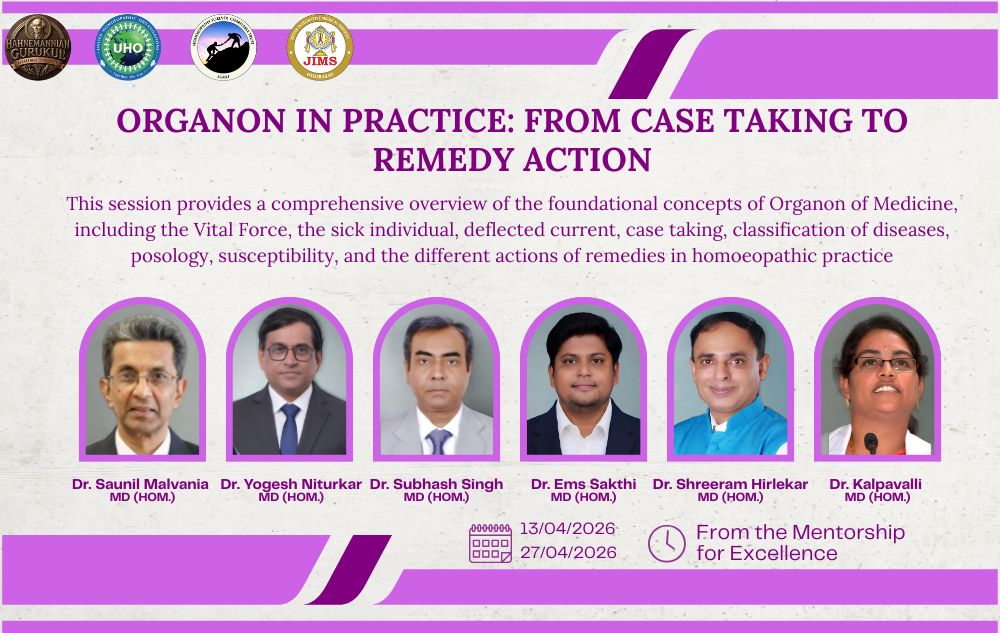
Recorded videos from the Mentorship for Excellence – Organon in Practice: From Case Taking to Remedy Actionseries conducted between 13th April and 27th April 2026, featuring Dr. Shreeram Hirlekar, Dr. Yogesh Niturkar, Dr. Saunil Malvania, Dr. Subhash Singh, Dr. Ems Sakthi, and Dr. Kalpavalli. The sessions focus on examination-oriented preparation, philosophical foundations of Organon, disease classification, susceptibility, case taking, homoeopathic posology, clinical reasoning, and the actions of remedies.
Dr. Shriram Halekar shares structured preparation techniques for 4th-year BHMS students, emphasising disciplined daily study, anxiety control via proper sleep, sequential point-wise writing, and direct referencing to impress examiners in theory papers.
The speaker provides strategic advice for medical students on how to effectively study, conceptualise, and structure exam answers for core homeopathic topics like "the sick" and "deflected current
It emphasises that a viva is not about rote memorisation, but rather about a student's ability to remain calm under pressure, communicate effectively, and successfully apply theoretical knowledge to real-world patient cases.
This session outlines why Hahnemann rejected rigid, fixed disease names to introduce a dynamic homoeopathic classification based on duration, scale, and underlying miasms. It emphasizes how understanding these acute and chronic categories dictates accurate clinical diagnosis and treatment strategy rather than mere exam memorization.
This video features a speaker outlining the definition, key components, and significance of susceptibility in homeopathic practice, as well as its historical views and relevance for university examinations.
The video outlines Dr. Hahnemann's homeopathic case-taking guidelines from aphorisms 83 to 104, emphasizing that a physician must use unbiased, detailed observations to record an accurate portrait of a patient's symptoms for proper remedy selection.
The speaker provides guidance on how to structure long exam answers using homeopathic posology as an example, emphasizing strategies like prioritizing common questions, allocating time based on question marks, and formatting with clear headings and conclusions.
The speaker provides an educational overview of how medicines affect the vital force, detailing primary action, secondary action (counteraction and curative action), and alternating action while explaining how these principles apply to homeopathic and allopathic treatments.
In this comprehensive eight-part module, experienced homoeopathic educators explore the core principles of Organon of Medicine and Homoeopathic Philosophy, providing students with a structured approach to understanding, applying, and presenting essential Organon concepts. The series combines philosophical foundations with practical clinical relevance, helping learners strengthen conceptual clarity, examination performance, and clinical reasoning.
The sessions cover examination-oriented preparation strategies, the concepts of Vital Force, The Sick and Deflected Current, Classification of Diseases, Susceptibility, Case Taking, Homoeopathic Posology, and the Primary, Secondary, and Alternating Actions of Remedies. Each lecture integrates theoretical knowledge with practical insights, enabling students to confidently approach university examinations as well as real-world homoeopathic practice. These topics align closely with core BHMS Organon competencies, including case taking, susceptibility, posology, disease classification, and remedy reactions.
Strategic Preparation for Organon Theory Examinations: Practical study methods, memory techniques, answer-writing strategies, revision planning, and examination preparation for Organon theory papers.
The Sick and Deflected Current: Understanding the philosophical concepts of "The Sick" and Deflected Current, their interpretation in Organon, and their clinical significance.
Clinical Reasoning and Viva Preparation: Examiner expectations, communication skills, structured clinical thinking, and practical approaches to succeeding in medical viva examinations.
Classification of Diseases: Hahnemann's classification of diseases, acute and chronic disease concepts, miasmatic understanding, and their application in diagnosis and treatment planning.
Susceptibility: Definition, determinants, clinical importance, and the role of susceptibility in remedy selection, disease progression, and patient management.
Case Taking: Principles of homoeopathic case taking, symptom observation, patient evaluation, totality of symptoms, and systematic case documentation for individualized prescribing.
Homoeopathic Posology: Fundamental principles of potency selection, dosage, repetition, follow-up, and practical approaches to answering examination questions on posology.
Primary, Secondary and Alternating Actions of Remedies: Understanding the different actions of medicines on the vital force, remedy response, and their therapeutic implications in homoeopathic practice.
Recorded videos from the Mentorship for Excellence – Organon in Practice: From Case Taking to Remedy Actionseries conducted between 13th April and 27th April 2026, featuring Dr. Shreeram Hirlekar, Dr. Yogesh Niturkar, Dr. Saunil Malvania, Dr. Subhash Singh, Dr. Ems Sakthi, and Dr. Kalpavalli. The sessions focus on examination-oriented preparation, philosophical foundations of Organon, disease classification, susceptibility, case taking, homoeopathic posology, clinical reasoning, and the actions of remedies.
We use cookies and anonymous visitor insights to enhance our website and improve your experience. By using our site, you agree to our use of cookies.
Manage your cookie preferences below:
Essential cookies enable basic functions and are necessary for the proper function of the website.